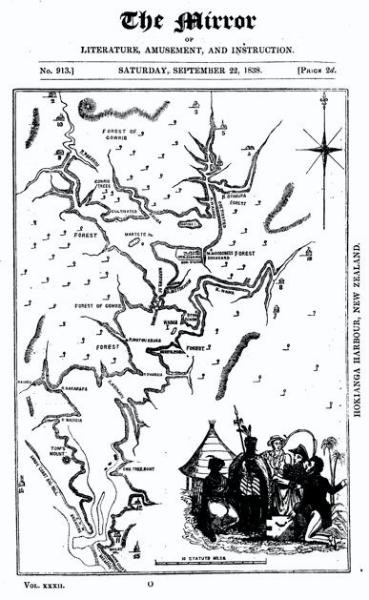
| An early map of the Hokianga as published in the Sydney Mirror in 1838. The first organised European settlement was said to have occured around 1827. Note that the place names already include the "Pilots House" at the Heads, "One Tree Point", "Motoukraka", the "Wesleyan Mission Station" and MacDonels (McDonells) Boatyard". Original in posession of Ken Baker |
THE MIRROR
Saturday, September 22, 1838
HOKIANGA HARBOUR, NEW ZEALAND
As it is in contemplation to establish a Settlement
in New Zealand, by a chartered Company, and the
subject having lately engrossed much attention,
we have given a Plan of the Harbour of Hokianga;
and intend to advert again to these interesting
islands.
Hokianga (Cook's Disappointment Harbour) is
situated twenty-four leagues south-east from Cape
Maria Van Dieman. " The approach to the harbour,"
says Mr. Pollock, "is narrow and intricate, and not
to be attempted with a ship drawing more than
fourteen feet water, unless well acquainted with
the harbour, which is navigable nearly thirty five
miles from its entrance : a number of rivers and
creeks of fresh water join this noble estuary.
"There are about one hundred Europeans settled
at Hokiauga, including the missionaries. Several of
the settlers are married to European females, who,
without exception, have set an example to the
native women, that has in no minor degree aided
the usefulness of the Wesleyan brethren, who
have been successful in their missionary exertions
throughout their districts. Unfortunately, a war
broke out in Hokianga, in 1837, on the subject of a
religious dispute, between those who placed
themselves under the banners of the Wesleyan
missionaries and some new idolaters, who term
themselves disciples of Pápáhurihia, and who
teach the people that the missionaries are cheats.
A native catechist of the Wesleyan mission went
forth to preach among the natives, who were
averse to the doctrines of the mission. The young
preacher was desired not to advance, but to leave
the settlement. This advice he disregarded, and,
in stepping forward, was shot through the body.
Some fighting was the consequence, in which the
idolaters suffered the most, who agreed to a treaty
of peace, and promised to sin no more"*
The Chart exhibits the localities of the chapels and
preaching-places us numbered, belonging to the
mission; and the beautiful spectacle is presented
of the light of divine truth efficaciously dispersing
from these recent wilds of heathenism, the
darkness of idolatry; and the voice of praise and
thanksgiving to a revealed God, succeeding to the
fell war-hoop and cannibal dance of savages. This
interesting colony owes an immense deal to the
self-denying labours and zeal of the Church
Missionary Society, which is watching over the
welfare of this remote region of the earth with
maternal solicitude, that the rapacity of commercial
enterprise may not altogether destroy the
principles of our holy religion, which the
missionaries have assiduously inculcated for
several years, amidst unparalleled difliculties.
Saturday, September 22, 1838
HOKIANGA HARBOUR, NEW ZEALAND
As it is in contemplation to establish a Settlement
in New Zealand, by a chartered Company, and the
subject having lately engrossed much attention,
we have given a Plan of the Harbour of Hokianga;
and intend to advert again to these interesting
islands.
Hokianga (Cook's Disappointment Harbour) is
situated twenty-four leagues south-east from Cape
Maria Van Dieman. " The approach to the harbour,"
says Mr. Pollock, "is narrow and intricate, and not
to be attempted with a ship drawing more than
fourteen feet water, unless well acquainted with
the harbour, which is navigable nearly thirty five
miles from its entrance : a number of rivers and
creeks of fresh water join this noble estuary.
"There are about one hundred Europeans settled
at Hokiauga, including the missionaries. Several of
the settlers are married to European females, who,
without exception, have set an example to the
native women, that has in no minor degree aided
the usefulness of the Wesleyan brethren, who
have been successful in their missionary exertions
throughout their districts. Unfortunately, a war
broke out in Hokianga, in 1837, on the subject of a
religious dispute, between those who placed
themselves under the banners of the Wesleyan
missionaries and some new idolaters, who term
themselves disciples of Pápáhurihia, and who
teach the people that the missionaries are cheats.
A native catechist of the Wesleyan mission went
forth to preach among the natives, who were
averse to the doctrines of the mission. The young
preacher was desired not to advance, but to leave
the settlement. This advice he disregarded, and,
in stepping forward, was shot through the body.
Some fighting was the consequence, in which the
idolaters suffered the most, who agreed to a treaty
of peace, and promised to sin no more"*
The Chart exhibits the localities of the chapels and
preaching-places us numbered, belonging to the
mission; and the beautiful spectacle is presented
of the light of divine truth efficaciously dispersing
from these recent wilds of heathenism, the
darkness of idolatry; and the voice of praise and
thanksgiving to a revealed God, succeeding to the
fell war-hoop and cannibal dance of savages. This
interesting colony owes an immense deal to the
self-denying labours and zeal of the Church
Missionary Society, which is watching over the
welfare of this remote region of the earth with
maternal solicitude, that the rapacity of commercial
enterprise may not altogether destroy the
principles of our holy religion, which the
missionaries have assiduously inculcated for
several years, amidst unparalleled difliculties.
"Your committee," says one of the last reports of the society,
"cannot close their statements without adverting to the peculiar
situation of New Zealand, as it is regarded by the public at large.
What events may await this fair portion of the globe; whether
England will regard, with a sister's eye, so beautiful an island,
placed like herself in a commanding position, well harboured,
well wooded, and fertile in resources; whether this country will
so stretch forth a vigorous and friendly arm, as that New
Zealand may, with her native population, adorn the page of
future history, as an industrious, well-ordered, and Christian
nation, it is not for the committee to anticipate; but this
consolation they do possess---they know that the society has,
for twenty years, done good for the natives, hoping for nothing
again;---nothing, saving the delight of promoting glory to God
and good-will among men. The society has sent its heralds of
peace and messengers of salvation, and has contracted thus
such an obligation towards those whom it has sought to benefit,
that your committee are constrained to lift up their voice on
behalf of that island, and to claim that no measures shall be
adopted towards that interesting country which would touch's
any violation of the principles of justice on our part, or of the
rights and liberties of the natives of New Zealand."
* Pollock's Travels in New Zealand, vol. ii. pp, 63, 64.
"cannot close their statements without adverting to the peculiar
situation of New Zealand, as it is regarded by the public at large.
What events may await this fair portion of the globe; whether
England will regard, with a sister's eye, so beautiful an island,
placed like herself in a commanding position, well harboured,
well wooded, and fertile in resources; whether this country will
so stretch forth a vigorous and friendly arm, as that New
Zealand may, with her native population, adorn the page of
future history, as an industrious, well-ordered, and Christian
nation, it is not for the committee to anticipate; but this
consolation they do possess---they know that the society has,
for twenty years, done good for the natives, hoping for nothing
again;---nothing, saving the delight of promoting glory to God
and good-will among men. The society has sent its heralds of
peace and messengers of salvation, and has contracted thus
such an obligation towards those whom it has sought to benefit,
that your committee are constrained to lift up their voice on
behalf of that island, and to claim that no measures shall be
adopted towards that interesting country which would touch's
any violation of the principles of justice on our part, or of the
rights and liberties of the natives of New Zealand."
* Pollock's Travels in New Zealand, vol. ii. pp, 63, 64.
| Article describing Hokianga and which appeared in the Sydney Mirror September 22, 1838 |
Updated: 15 March 2019
Website Owner: Dr. Kenneth M. Baker
info(at)ourhokianga.com
Website Owner: Dr. Kenneth M. Baker
info(at)ourhokianga.com
| Hokianga History and Memorabilia |